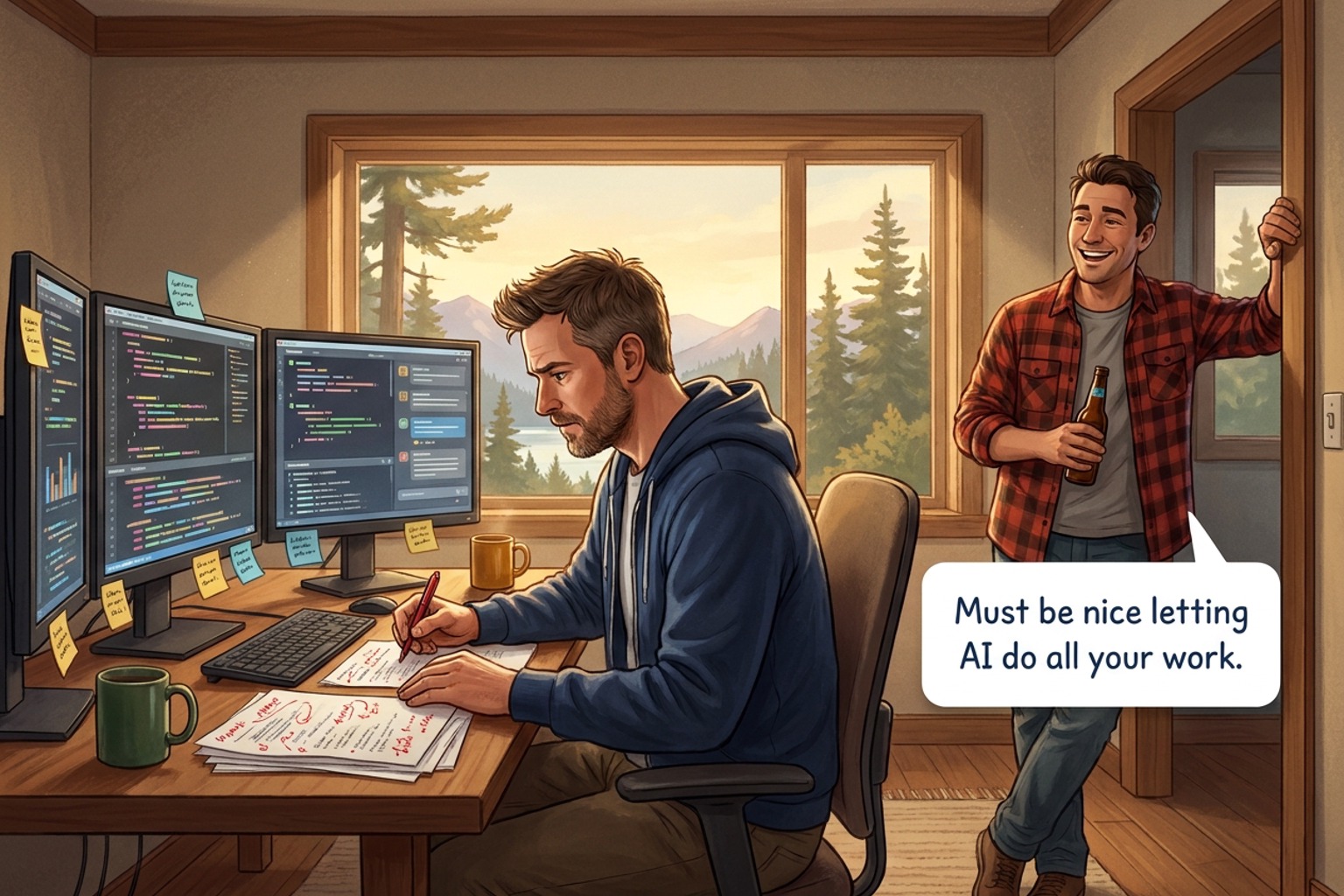
A few friends keep calling me lazy for how much I use AI. I get why. From the outside, it looks like I talk to my computer and the work just shows up. They're missing the point.
Getting AI to do work at the quality I'd do it myself is hard. I'm not working less. I'm working more. I just have a different job now.
Why it looks lazy from the outside
Most of us judge effort by what we can see. Typing looks like work. Swinging a hammer looks like work. Reading something for ten minutes and then typing two sentences back does not.
When a friend watches me work now, they see me describe a task, wait a minute, and get back a pile of code or a finished draft. It looks like a magic trick. What they don't see is everything that makes the trick work: the instructions I've been writing for over a year, the review of everything that comes back, the rounds of "no, not like that," and the judgment call on whether it's right.
The effort didn't go away. It moved somewhere you can't see.
Nobody calls a founder lazy for hiring a team
Picture a founder who wrote every line of the first version of their product. The company takes off, and they hire five engineers. Now that founder spends the day writing specs, answering questions, reviewing pull requests, and catching misunderstandings before they turn into bugs.
Nobody calls that founder lazy. Nobody says, "Must be nice to have other people do your work." Everyone understands that managing people takes real time. The founder didn't stop working. They changed what their job is.
That's what happened to me. The team I manage just happens to be AI.
Andy Grove, the longtime CEO of Intel, wrote the rule for this in High Output Management:
"A manager's output = The output of his organization + The output of the neighboring organizations under his influence."
Nobody measures a manager by how many words they typed. You measure them by what their team ships. Judge me the same way.
"It's faster if I just do it myself"
Every new manager hits the same wall. You hand off a task. It comes back wrong. You explain it again. It comes back closer. And you think: I could have done this myself in half the time.
In the short run, you're right. Your first hire almost always slows you down before they speed you up. You push through anyway, because the time you spend teaching them now buys you years of leverage later.
AI works the same way. When you first start using it for serious work, it's slower than doing the work yourself. A lot of people try it, hit that wall, and quit. They decide AI is overhyped. Other people try it, skip the hard part, and ship whatever comes back. That's where AI slop comes from.
Both groups missed the job, which is the part in the middle. Managing.
What managing an AI team looks like
When I map my day onto a normal manager's job, it lines up almost one to one:
Hiring
Picking the right model and tools for the work.
Onboarding
Writing the instructions and skills that teach it how I do things.
Delegating
Writing a clear task, usually as a detailed GitHub issue.
Reviewing
Reading what comes back before it goes anywhere.
Coaching
Fixing the mistake, then writing the lesson down so it sticks.
Owning the result
My name is on it, not the AI's.
Two differences make the AI version harder in some ways, not easier.
Every day is its first day. A good employee learns. After a few months, they know how you like things done. AI doesn't remember yesterday unless you wrote yesterday down. Every new session is a new hire walking in the door. That's why so much of my job is writing things down. Autumn, my personal assistant, runs on a playbook of instructions and skills that I keep adding to. When it gets something wrong, I don't just fix the output. I fix the playbook, so the next "new hire" gets it right.
It's confident when it's wrong. A junior employee who's unsure will usually come ask you. AI almost never says "I'm not sure." It hands you broken work in the same cheerful tone as perfect work. In my post on whether CEOs should fire their developers, I described the split I see: about 70% of the time AI nails it, 20% of the time it needs reshaping, and 10% of the time it goes off the rails. The catch is you never know ahead of time which bucket you're in. So you check everything.
Checking everything is not lazy. It's the job.
Why I'm working more, not less
This is the part my friends get most wrong. They assume I'm doing the same work in less time and spending the rest of the day on the golf course. That's not what happened.
AI takes the easy work and leaves me the hard work
Before AI, my day was a mix. Some hard thinking, with a lot of easy work in between. Boilerplate code. Formatting. Filling in the obvious parts. That easy work was almost restful. It gave my brain a break between the tough calls.
Now AI does the easy work. What's left for me is the hard stuff: the decisions, the tradeoffs, the "is this right?" calls, and the 10% that went off the rails. My whole day is the hard parts now. Ask any executive what a day of nothing but decisions feels like. It wears you out in a way typing never did.
The team is fast, so I'm the bottleneck
A human team gives you breathing room. You hand out work in the morning and see results the next day. AI hands you the next batch in minutes. I often have several agents running at once in different terminal windows, and each one is waiting on my review, my answer, or my decision. That's a lot of direct reports, and none of them take a lunch break.
The bar went up
When your team can do more, you don't ask for the same amount. You ask for more. I'm taking on far more than I used to: a command-line tool for my broker, a screenshot tool, an Apple Store inventory watcher, and a personal assistant that handles a big chunk of my life admin. Every one of those is one more thing to plan, review, and keep running.
AI didn't shrink my workload. It made my ambitions bigger, and my workload grew to match.
Yes, there is a lazy way to use AI
To be fair to my friends, lazy AI use is real. You've seen it. The LinkedIn post nobody edited. The pull request nobody read before opening it. The customer email with "[Insert name here]" still in it.
That's the absentee boss. They hand out work, never check it, and ship whatever comes back. The problem isn't the team. It's the manager.
Programmers have a long history with this word. Larry Wall, the creator of Perl, called laziness one of the three great virtues of a programmer. His definition of it: "The quality that makes you go to great effort to reduce overall energy expenditure." That's the good kind of lazy. It's me spending an afternoon writing a skill so I never have to explain a process again. It takes real effort. That's the whole point.
The bad kind of lazy is not caring whether the result is right. AI amplifies both kinds. It doesn't make anyone lazy. It just makes it very easy to see who's a good manager and who isn't.
And "the AI did it" is never an excuse. It's the new "we have a new system." You chose the tool. You shipped the work. It's yours.
Managing is a skill most people never practiced
Here's why I think this matters a lot over the next few years. Most people have never managed anyone. They've spent their whole careers as the one doing the work.
We already know what happens when you promote a great doer into a manager with no training. A lot of them struggle. Some micromanage and redo everything themselves. Others hand off the work and disappear.
The same thing is happening with AI right now, to millions of people at once. Almost overnight, anyone with a laptop got a team. Very few of them got any training on how to run one.
The people who do well won't be the ones who type the fastest. They'll be the ones who set a clear goal, give good context, review carefully, and write down what they learn. Those are manager skills. They always have been.
My challenge to my friends
If you still think using AI is the lazy way out, try this. Pick something you're great at. Something you'd put your name on. Now get AI to do it at the same quality you would. Not close enough. Your level.
Then come tell me it's lazy.
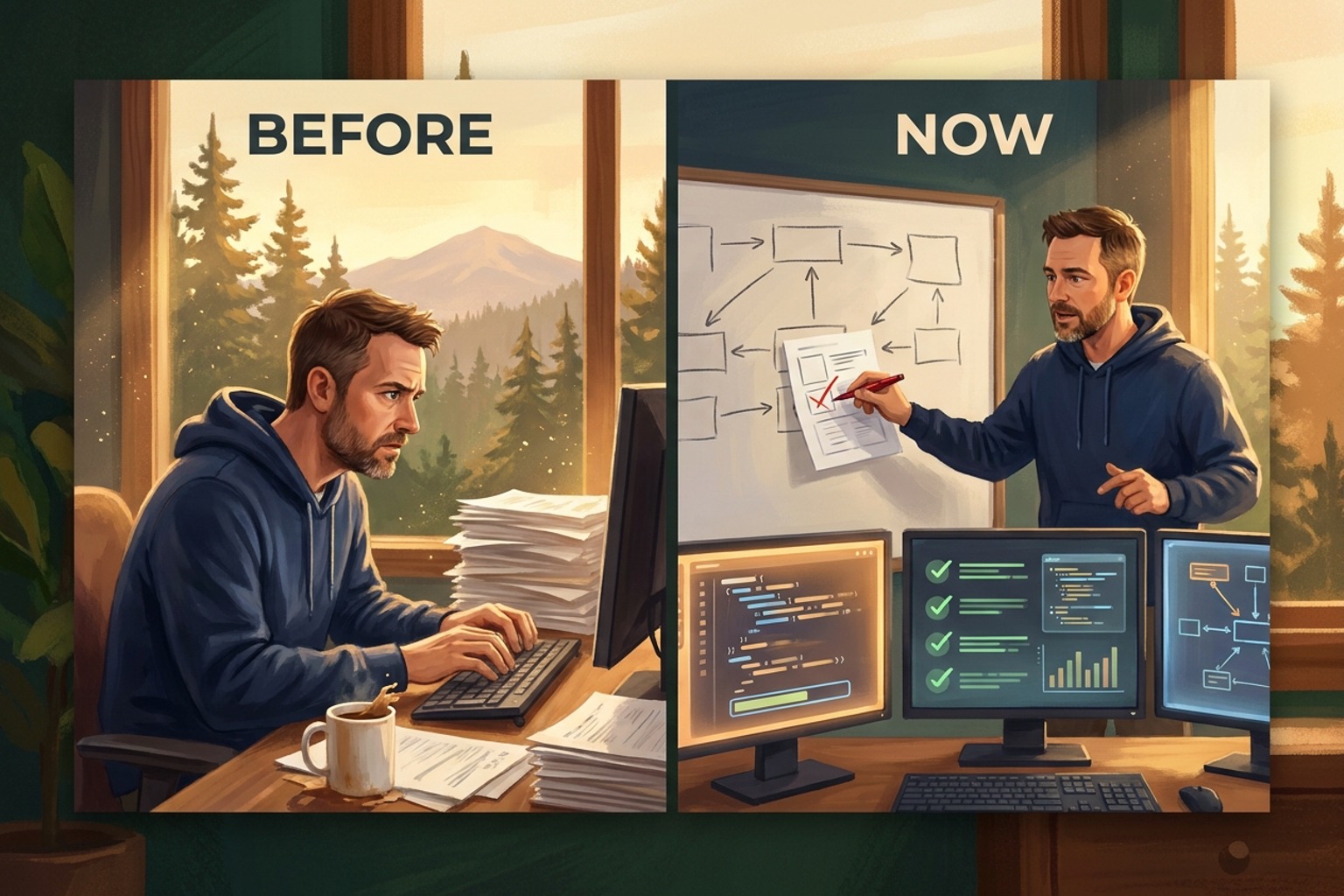
I used to be the one cranking out the work. Now I'm the one managing the team that cranks it out.
Far from lazy. Far from easy.