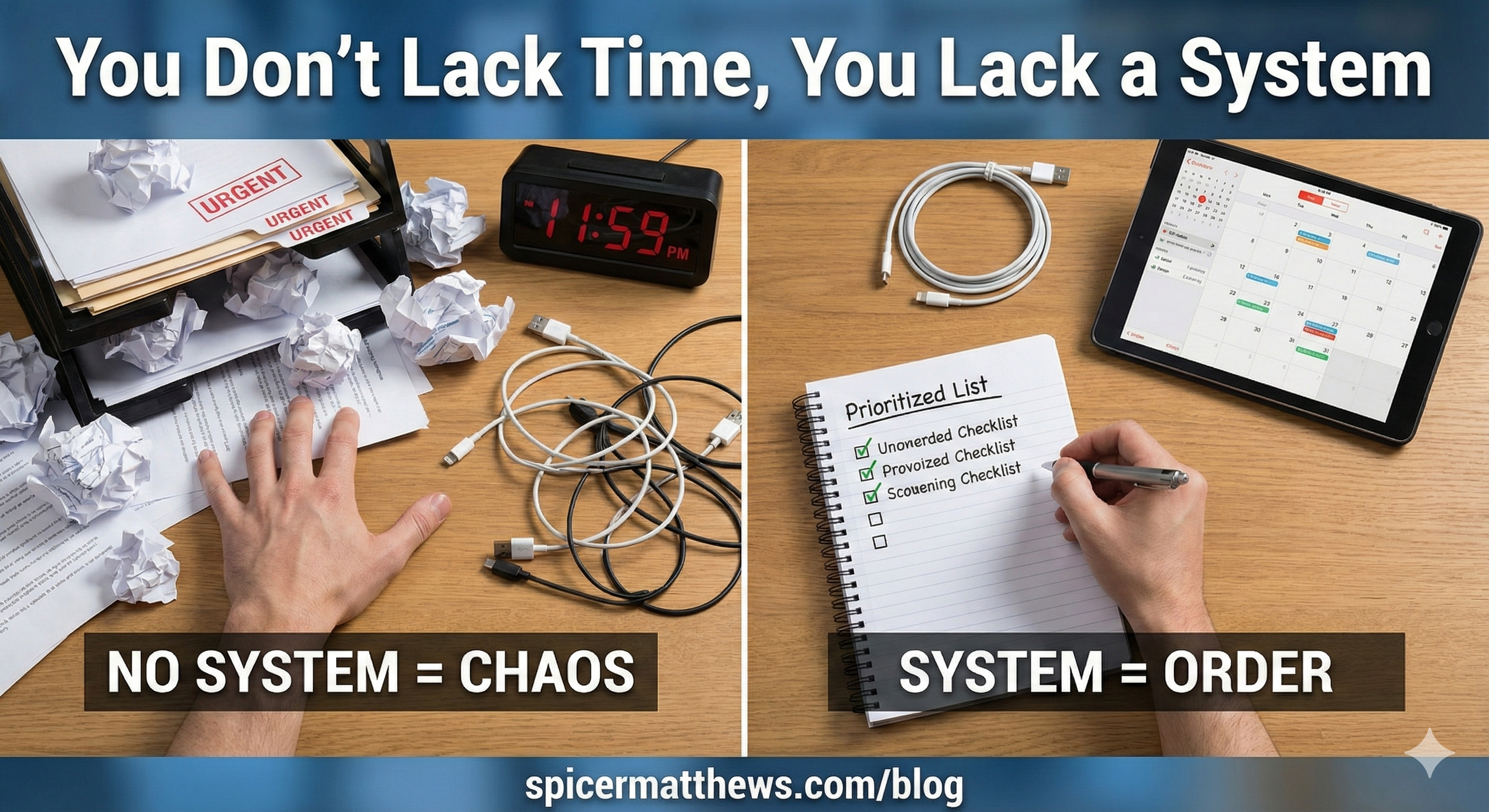
I came across a quote from Jesse Itzler recently that stuck with me more than I expected:
"You don't lack time. You lack a system."
— Jesse Itzler
At first, it sounded obvious—almost too neat. But the more I sat with it, the more I realized why it bothered me. Not because it was wrong, but because it described how I've been living for years without ever quite putting words to it.
I Stopped Answering the Phone
One of the earliest examples goes back to a decision I made a long time ago: I stopped answering the phone.
Not in a dramatic way. I didn't announce it or make a big deal out of it. I just noticed that phone calls were quietly consuming far more time than they deserved. I remember looking at my voicemails one day and doing a bit of back-of-the-napkin math.
If each callback took about ten minutes—and most of them did—that added up to roughly four full days of my year spent returning calls.
Four days of pleasantries, context switching, and winding conversations before getting to whatever the actual point was.
So I changed the system.
My voicemail now says that if something is urgent, leave a message and I'll call back. Otherwise, text or email me to start the conversation. Most things don't actually require a live call. And when they do, we schedule one at a time that works for both of us.
Nothing about access changed. The outcomes didn't change. But my days got noticeably quieter and more focused.
The Rule: Don't Do It Twice
Once I started noticing this pattern, I realized I was doing it in other parts of my life too.
I've developed a personal rule over time:
If I don't enjoy doing something and it's repetitive, I don't do it twice.
Laundry is the obvious example. I don't like doing laundry. It's not relaxing. It's not creative. It doesn't add anything meaningful to my life. So I outsource it.
That decision isn't about convenience—it's about attention. I'm intentionally trading money for time and mental energy. And once you start thinking that way, you see opportunities everywhere.
- Anything repetitive gets automated
- Anything uninteresting gets outsourced
- Anything unnecessary gets eliminated
Over time, that creates a life where most of my effort is spent on things I actually care about.
Even Small Things Matter
I eat more Chick-fil-A than I probably should. The drive-through line is often long enough that I could sit in my car for twenty minutes just inching forward. Mobile ordering lets me skip the line and pull straight to the front.
It sounds trivial, but it buys back twenty minutes.
People tend to dismiss optimizations like that because they're "only" saving a little time. But that's missing the point.
Compound Effect
Twenty minutes here, twenty minutes there—it adds up fast.
Reduced Friction
Less waiting. Less annoyance. Less mental drag.
Intentional Structure
That same thinking shows up in how I structure my days.
- I don't respond to emails constantly—I have specific times for it
- I don't answer text messages all day—I batch them
- I have a routine to start my day and a routine to end it
By carving out time intentionally, everything else in between becomes more efficient. I'm not reacting all day long. I'm deciding when things happen.
This is inspired by ideas like Deep Work from Cal Newport—the concept that focused, uninterrupted work is where real value gets created. Constant context-switching is the enemy of getting meaningful things done.
The Realization
That's what that quote helped crystallize for me.
I don't actually need more time. Most of us don't.
What we need are systems that:
Small changes compound. Habits turn into structure. And structure quietly creates space—for focus, creativity, and the things that actually matter.
You don't lack time.
You just lack a system.