On August 1st, Harbor went live. It's a private, own-it-for-life note-taking and document app — notes, scans, photos, PDFs, recordings, web clips — built by Cloudmanic Labs, the company I founded and still run.
It's also the most personal thing I've built in a long time, because I spent 15 years as an Evernote customer before I finally admitted I didn't trust it anymore.
"I didn't want to build another notes app. I wanted the one I already had to keep its promise."
I Didn't Just Use Evernote. I Built On It.
This wasn't a casual relationship. I was in that ecosystem as a developer, not just a customer.
Back when Evernote had a real platform and a real marketplace, Cloudmanic Labs shipped apps on top of it. Photomanic was a photo gallery built entirely on the Evernote API — we went from concept to launch in under 30 days and entered it in the Evernote DevCup. Evermanic was an iPhone app for capturing repeatable note templates straight into Evernote. I even open-sourced an Evernote PHP library so other developers could build on it too.
I believed in the thing. One private place for everything you keep, forever. That was the pitch, and it was the right pitch. My whole life went in there — scanned contracts, receipts, my kids' drawings, meeting recordings, 15 years of notes I assumed would outlive whatever laptop I happened to be holding.
Then It Stopped Being the Product I Signed Up For
Evernote was sold to Bending Spoons, and the incentives changed. Not overnight, and not maliciously — just predictably, the way they always change when a product becomes an asset to squeeze.
The price roughly doubled
I could live with paying more for something getting better. That's not what happened.
The bugs never got fixed
The Web Clipper — arguably the reason to use Evernote at all — has been broken for me for something like five years.
AI I never asked for
Feature after feature bolted on, then used to justify charging more. I already pay for Claude. I don't need a weaker one in my notes app.
It never got faster
The native apps I loved became heavy software that pins my CPU and feels like a web page in a costume.
Here's the part that actually bothered me, though. None of that is a feature complaint. It's a trust problem.
A second brain only works if you believe it will still be there, still be affordable, and still be yours in ten years. The day I stopped believing that, Evernote stopped doing its job — even though every note was still sitting right where I left it. And leaving felt impossible, because leaving meant abandoning 15 years of my life. That's not loyalty. That's gravity.
That's not a second brain.
That's a hostage situation.
So We Built Harbor
I was committed to this community — note-taking, document archiving, the whole "keep everything, find anything" idea — for over 15 years. Watching it get worse while I had a company perfectly capable of doing something about it started to feel ridiculous.
So Cloudmanic Labs built Harbor.
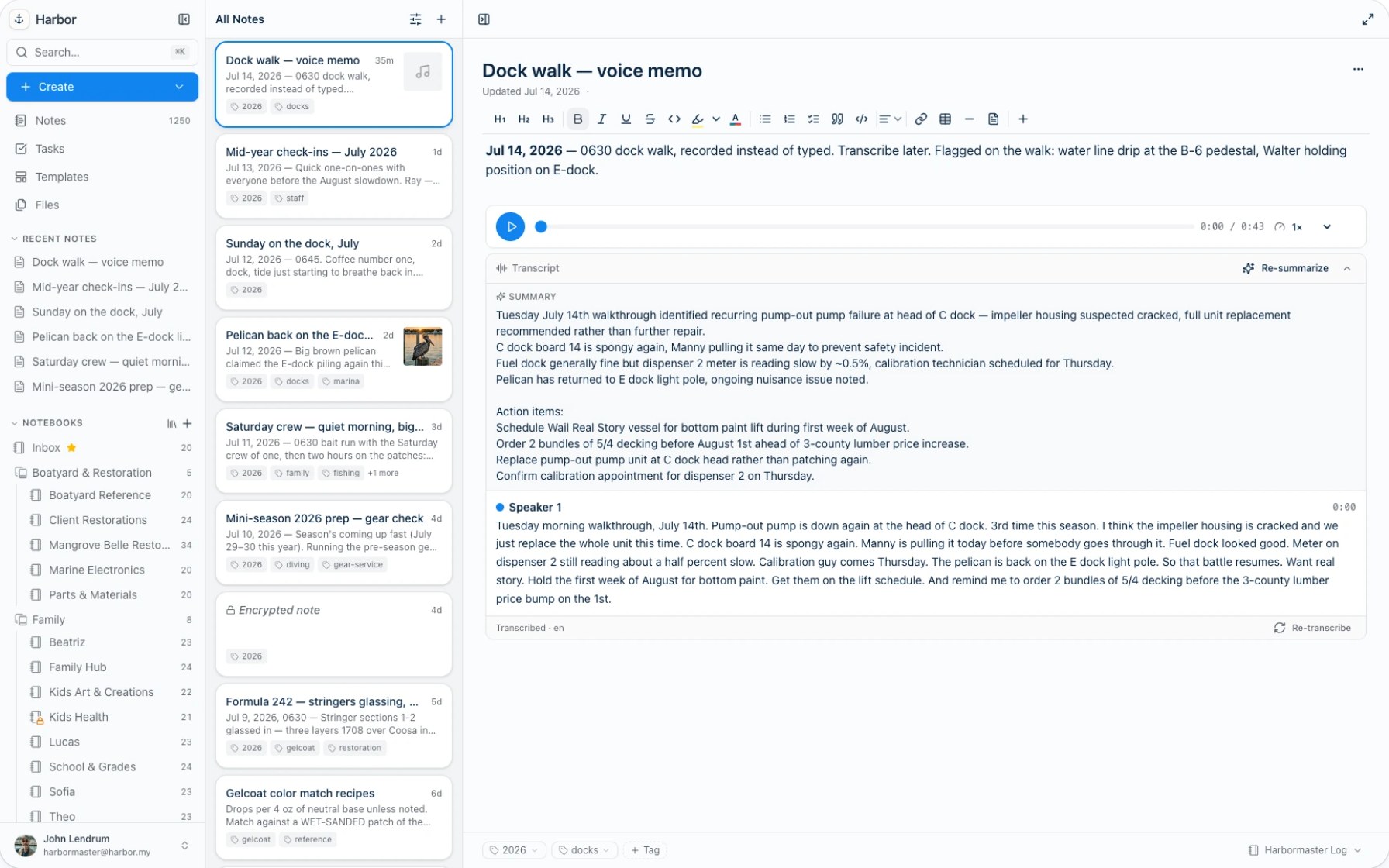
Harbor on the desktop — notebooks and notes, plus recordings that get transcribed and become searchable.
The baseline goal was unglamorous: feature parity with Evernote. Notebooks and notes. Tags. Document scanning. OCR that reads the words inside your photos, scanned PDFs, and even handwriting. A Web Clipper that actually works. Tasks, reminders, templates, version history, shared links. Offline on every device. If you're moving 15 years of your life, "almost everything you had" isn't good enough.
Parity gets you considered. It doesn't get you trusted. So there are four places where Harbor deliberately doesn't work the way Evernote does.
1. Encryption Is a First-Class Citizen
Your Evernote notes sit on their servers in a form their employees can read. That's normal for the industry, and it's been quietly true the entire time you've been scanning tax documents into it.
Harbor offers zero-knowledge encryption on any note or notebook you choose. Content is encrypted on your device before it ever reaches us, which means we genuinely cannot read it.
And we say the trade-off out loud, because pretending there isn't one is how you lose people: an encrypted note drops out of OCR, out of search, and out of reach of any AI you connect. So you lock down the sensitive things and leave the rest fully powered. It's a switch you control, per item — not a marketing checkbox and not an all-or-nothing default that quietly makes the product worse.
2. A Price Promise, in Writing
I've written before about how much I hate vendors who won't be straight about pricing. Getting my own note-taking bill doubled made it personal.
$99 a year (or $9.99 a month). No increase for three years. After that, capped at 10% a year.
Published on the site, not buried in a terms update.
There's a corollary that matters just as much: stop paying and your memories don't vanish. Your account goes read-only and free, and you can still export or delete everything. We want people to stay because Harbor is good, not because the exit is painful.
3. Getting In and Out Is Genuinely Easy
Exporting from Evernote is harder than it should be, and I don't think that's an accident. It's the single biggest reason people who hate it keep paying for it.
Moving into Harbor is one step: export your ENEX file, import it, and your notebooks, tags, checklists, and attachments come across intact. The door out is exactly as wide — full export to ENEX, HTML, or ZIP, anytime, plus a complete account export.
Building an easy exit into your own product feels backwards until you realize it's the only version of the promise that's actually credible.
4. A Real API, CLI, and MCP Server
This one's the developer in me refusing to let go. Evernote had a public API and a genuine developer ecosystem once — I know, because I built on it — and then it was left to rot.
Harbor ships with a REST API, a command-line tool, and an MCP server. That last one is the interesting part in 2026: it means the AI you already pay for can read and write your notes directly. I use it constantly — my personal assistant and my coding agents file notes into Harbor and pull context back out of it without me touching a UI.
That's the philosophy: Harbor doesn't ship a built-in AI to pad the bill. It opens the door to yours, on tokens you create and revoke.
And One Thing That Isn't a Feature
Cloudmanic Labs is independent. No outside investors, no board pushing for an exit, nobody whose returns depend on finding out how much more you'll tolerate paying.
That's not a moral claim, it's a structural one. It's the reason a three-year price lock is something we can actually promise — and the reason "personal, never enterprise" is a decision instead of a phase.
What's Live Today
Desktop
Native Mac and Windows apps, including a Windows on ARM build. No Electron.
Mobile
iPhone, iPad, and Android — camera scanning, widgets, share sheet, Face ID lock.
Web
A real app in the browser with a database inside it, so even the web works offline.
Web Clipper
Chrome, Edge, Firefox, and Safari. Articles, full pages, bookmarks, screenshots — annotate before it lands.
Plus email-to-notes, OCR search across everything, audio transcription with speaker labels, and the API, CLI, and MCP server. There's a free plan to start, and the paid plan is one plan — no "Pro vs. Premium" maze where the feature you need is always one tier up.
My Notes Live There Now
The real test wasn't the launch. It was moving my own 15 years in and deleting the old app, which I've now done.
We're not chasing an exit with this one. Harbor is meant to be the place we keep our own lives, and it needs to still be here in twenty years for that to mean anything. If you've been sitting on a note library you don't love anymore because leaving felt like too much work, the import is one step and the free plan doesn't need a credit card.
Anchored. Private. Yours.
Take a look at harbor.my — and hold us to every word of it.